Lake Mburo National Park holds a unique distinction among Uganda’s protected areas. It is the only savannah park in the country where guided walking safaris are conducted on a regular basis, offering visitors a rare opportunity to leave the vehicle behind and explore the bush on foot. This intimate and thrilling way to experience Uganda’s wildlife allows you to connect with nature in a way that vehicles simply cannot provide.
The most significant reason Lake Mburo stands apart as a walking safari destination is what the park does not have elephantsand lions. Unlike Uganda’s larger savannah parks such as Murchison Falls and Queen Elizabeth, Lake Mburo has no elephants and no lions. This distinction matters enormously on a walking safari. Elephants are the animal most responsible for human fatalities in African wildlife encounters, being large, fast, unpredictable, and capable of charging with very little warning. Lions, meanwhile, are the predator that most visitors instinctively worry about, and Lake Mburo has none.
The absence of major predators creates a walking environment that is fundamentally safer than most savannah parks in East Africa. Leopards do live in Lake Mburo, but they are naturally nocturnal and deeply secretive. During daylight hours, when walking safaris take place, leopards actively avoid human contact, making encounters extraordinarily uncommon. While the park still has potentially dangerous animals such as buffaloes, hippos, and crocodiles, the reduced risk profile makes Lake Mburo one of the finest and most accessible walking safari destinations in all of Uganda.
All walking safaris in Lake Mburo are conducted with armed Uganda Wildlife Authority ranger guides who ensure visitor safety at all times. The rangers assigned to walking safaris are specialists trained in wildlife behavior, threat assessment, emergency response, and the safe management of close wildlife encounters. They carry firearms as a precaution, trained to fire warning shots into the air if an animal behaves unexpectedly or moves too close to the group, though this deterrent is used extremely rarely.
Before every walking safari, your ranger conducts a mandatory safety briefing. This covers wildlife behavior, how different animals are likely to react to human presence, trail etiquette, and emergency protocols. You will know exactly what to do if an animal approaches, if the group needs to retreat quickly, or if any other unexpected situation arises.
Walking safari routes in Lake Mburo are not fixed. They are planned dynamically based on real-time wildlife tracking and current animal locations. Rangers assess where specific animals, particularly buffalo herds which are the most common source of potential risk, have been sighted before the walk begins each day. If a territorial buffalo herd is known to be in a particular area, that zone is deliberately avoided and the route adjusted accordingly.
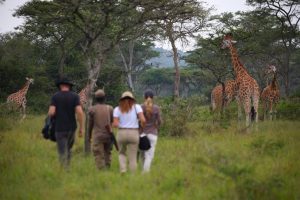
Guided nature walks in Lake Mburo National Park are conducted along the Rwonyo trails, a network of paths that winds through the park’s woodland and savannah habitats from the main Rwonyo rest camp. Walks typically depart at around 7:00 AM, the optimal time for wildlife activity when the air is cool and nocturnal species are completing their final movements before retreating to cover. The standard walk lasts two to three hours, covering enough ground to encounter a meaningful variety of wildlife and habitats while remaining comfortable for visitors of all fitness levels.
Unlike game drives where you observe wildlife from inside a vehicle, walking safaris allow you to experience the bush using all your senses. You hear bird calls clearly, notice animal tracks on the ground, and observe small details like insects, plants, and animal droppings that vehicles often pass by. There is something fundamentally different about encountering wildlife on foot no engine noise, no vehicle between you and the landscape, just the sound of footsteps on a trail, the smell of the bush in the early morning, and the particular alertness that comes from moving through wild country at a human pace.
The variety of mammals visible on a Lake Mburo walking safari is consistently impressive. Zebras are among the most abundant species in the park, and encountering a herd at close range on foot, close enough to hear them breathing, is an experience of an entirely different order from watching the same animals from a game-drive vehicle. Giraffes move through the woodland with their characteristic deliberate grace, impalas scatter and regroup in the characteristic fashion that makes them endlessly watchable, and eland, Africa’s largest antelope, moves with surprising quietness through the acacia trees.
Hippos are visible along the lake margins, and crocodiles bask on exposed banks in the afternoon sun. Other commonly encountered species include topis, Defassa waterbucks, warthogs, bushbucks, and buffaloes. The walk up into the hills above the Rwonyo valley is rewarded with a panoramic view across the park that encompasses multiple lakes simultaneously, a perspective that reveals the full beauty and scale of the Lake Mburo landscape.
For birding enthusiasts, the guided nature walk at Lake Mburo is one of the finest low-intensity birding experiences in Uganda. The park records over 350 bird species distributed across its varied habitats, and the walking pace allows observation of species that a moving vehicle would disturb before they could be properly identified. Notable species regularly encountered include the African finfoot, papyrus gonolek, African fish eagle, and various barbets and tinkerbirds.
Several distinct trails offer different experiences within the park. The Rwonyo Salt Lick area is where visitors can encounter a large concentration of wildlife gathering to enjoy mineral-rich salt deposits, with topis, impalas, and zebras commonly seen. The Lake Shorelines offer excellent birding tours and game viewing with a chance to spot hippos. The Rubanga Forest is one of the best birding spots, with species including the red-headed lovebirds, grey-backed camaroptera, green wood hoopoe, and the elusive shoebill stork.
The Kazuma Lookout Trail ascends the eastern escarpment, offering a cardiovascular challenge and a bird’s-eye view of the entire park, the shimmering lake, and the distant blue hills of the greater Ankole region. It is an ideal spot for a packed breakfast or a sundowner, watching the shadows lengthen over the savannah. The Swamp Fringe Walk takes visitors along the seasonal papyrus swamps, a different ecosystem entirely, where the endemic papyrus gonolek can be spotted and the giant kingfishers dive like torpedoes into the murky water.
The cost of nature walking safari in Lake Mburo National Park varies depending on the visitor category. Foreign non-residents can go for a walk at USD 25 per person, foreign residents pay USD 20 per person, and East African community citizens pay shs. 20,000 per visitor. In addition to the walking safari fee, the park entrance fee applies: foreign non-residents pay USD 40 per visitor, foreign residents pay USD 30, and East African community citizens pay shs. 20,000.
Bookings are best made in advance through Exclusive Gorilla Vacations or directly with the Uganda Wildlife Authority. All walks require a ranger guide, and group sizes are carefully managed to ensure safety and quality of experience. A typical walking safari covers 3 to 6 kilometers, often off-trail, with the exact distance depending on the chosen route and wildlife activity.
Walking safaris in Lake Mburo operate year-round, but certain months offer better conditions. The dry season from June to September and December to February is considered the prime time for walking. During these months, vegetation is sparse, giving clear lines of sight across the savannah. Animals congregate around the few remaining permanent water sources, making them highly predictable and easy to locate. The trails are firm, and the risk of encountering deep mud is minimal.
The rainy season, from March to May and October to November, offers a vastly different but equally rewarding experience. The park explodes into life with vibrant green foliage and an influx of migratory birds, making this the premier time for birders. However, trails become slippery, and some routes may be inaccessible due to mud. The taller grass reduces visibility, making wildlife encounters more sudden and thrilling. Waterproof hiking boots and light rain gear are essential during this time.
Proper preparation ensures a comfortable and enjoyable walking safari. Recommended items include comfortable, waterproof walking boots, a camera with a good zoom lens, binoculars for bird and wildlife spotting, a waterproof daypack, sunscreen and insect repellent, sunglasses and a safari hat, long-sleeved shirts and neutral-toned clothing, and a reusable water bottle.
Checking with your lodge or tour operator about specific requirements, especially weight limits for any other activities, is worth confirming before you arrive rather than discovering a restriction on the day.
Walking safaris in Lake Mburo National Park offer a rare and intimate way to experience Uganda’s wildlife. Instead of watching animals from behind a car window, you step directly into their world, guided safely by professional rangers. The park’s unique position as a predator-free savannah, combined with the expertise of Uganda Wildlife Authority rangers, makes this one of the safest and most rewarding walking safari experiences in East Africa. The experience is peaceful, thrilling, and deeply memorable a chance to connect with nature in a way that vehicles simply cannot provide.
At Exclusive Gorilla Vacations, we specialise in crafting custom safaris that include walking safaris in Lake Mburo as part of a broader Ugandan adventure. We handle all permits, logistics, and bookings, ensuring your experience is seamless and unforgettable.
Ready to step into the wild? Contact our team today to start planning your custom safari.